
Bitcoin mining sits at a curious crossroads where technology, economics, and human behaviour overlap. It is powered by a familiar force—speculation—but it behaves in a way that sets it apart from many speculative industries that came before it.
A Different Kind of Risk
Throughout modern history, economic booms have tended to spill their risks outward. Railroads, telecom infrastructure, mortgage derivatives, biotech bubbles—each created waves of optimism followed by painful collapses. And when those collapses came, the burden was rarely limited to the investors who chose to participate. Employees, communities, pension funds, and entire regions often absorbed the fallout.
Bitcoin mining is built on similar cycles of exuberance and contraction, yet its consequences are strangely contained.
Mining companies rise and fall at a rapid pace. Machines are bought, plugged in, unplugged, and auctioned off. Investors come and go. But when a mining operation fails, the effects remain almost entirely internal. A warehouse goes dark; a balance sheet is written off; the participants move on. The broader world remains largely untouched.
Self-Contained Speculation
This self-contained nature makes Bitcoin mining an unusual form of economic experimentation. The risks are real, but they are borne almost exclusively by those who volunteered for them. The network absorbs operational failures through its automatic difficulty adjustments. There is no contagion effect, no systemic shock, no wider social harm.
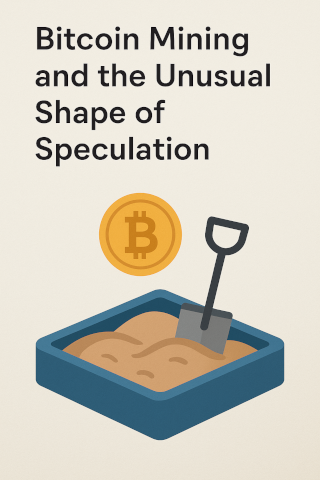
In this sense, mining behaves like a “sandbox” for speculative ambition. It allows people to take big risks—sometimes unreasonably big—without exporting the consequences to those who never agreed to participate.
It is still messy, still driven by hope, fear, and miscalculation. But it fails gracefully.
A Small, Quiet Optimism
Speculation, for better or worse, is a permanent feature of human economies. People will always place bets on the future—sometimes wisely, sometimes not. If that’s the case, perhaps it’s better for speculative behaviour to occur in domains where the harm is tightly bound.
Bitcoin mining hints at that possibility.
It demonstrates that an industry can be fueled by ambition, shaped by competition, and prone to collapse—while still avoiding the kind of social damage that traditional financial bubbles often leave behind.
Maybe this is only a small improvement. But small improvements matter.
If humans are going to reinvent their successes, they might as well reinvent their failures, too—designing systems that break softly instead of catastrophically. Bitcoin mining, for all its imperfections, edges us a little closer to that idea.
Leave a Reply